
Diversity and resilience
How balanced is my ecosystem?
See how rich, even, and resilient your microbial community is, and how it compares with a healthy reference.

Microbiome sequencing · Your inner garden
Your gut ecosystem shapes your energy, mood, cravings, immunity, and how well you age. Microbiome sequencing shows who lives there and how they are doing, so your plan feeds the right garden.
Built for healthspan. I use GutID by Intus Bio to read gut-axis signals and guide your nutrition and lifestyle choices.
Why it matters
Think of your gut as the soil of an inner garden. When the soil is balanced, energy, digestion, mood, and immunity tend to follow. When it is out of balance, even the healthiest plan struggles to take root.
Microbiome sequencing reads the DNA of the microbes in a small stool sample. It shows how diverse and resilient your ecosystem is, which species are thriving, and how your gut connects to your brain, metabolism, heart, and immune system.
Then we turn the data into choices: the foods, fibers, and habits that feed the microbes you want, and targeted support only when your data shows a need.

From data to your plate
Every gut ecosystem is unique. Your report helps us stop guessing and support yours.
Diversity and resilience
See how rich, even, and resilient your microbial community is, and how it compares with a healthy reference.
Helpful and harmful microbes
Spot the beneficial bacteria to feed and the potentially harmful ones to crowd out.
Gut-brain axis
Explore the signals your gut sends to your brain, linked with energy, mood, and mental clarity.
Gut-metabolism axis
Connect your microbes with cravings, weight, and glucose patterns.
Gut-immune axis
Read markers related to inflammation and immune balance alongside the rest of your data.
Progress over time
A retest after a targeted plan shows how your ecosystem responded.
The test I use
Complete Microbiome Assessment (CMA) by GutID, by Intus Bio
I use GutID's Complete Microbiome Assessment. Its Titan-1 long-read sequencing identifies gut bacteria down to the strain level, a far sharper picture than a basic species list. The report scores your ecosystem, maps four gut-body axes, and comes with food and supplement insights we turn into your plan.
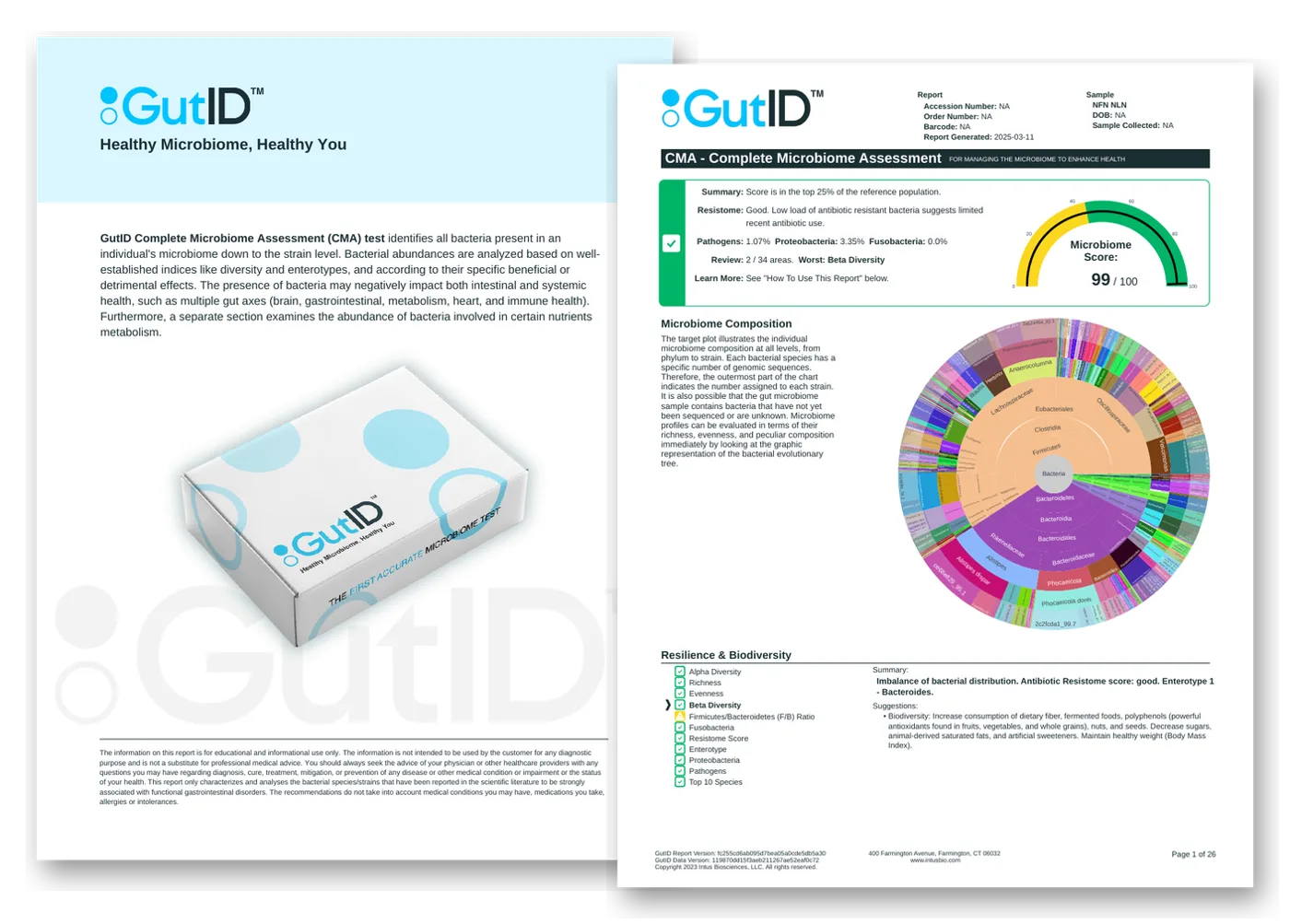
Summarized from GutID's published test information. I use the report to read gut-axis signals and guide nutrition and lifestyle choices for your healthspan. It does not diagnose any condition.
Your microbiome package
You receive more than a list of bacteria. I help you understand what your ecosystem is signaling and what to do first.
We talk about your goals on a free discovery call and review anything you take that could affect results.
Your kit arrives at your door. Collect a small sample in a few minutes and mail it back.
Once your report arrives, we meet virtually to read it in plain language.
Follow your targeted plan, then retest to see how your gut ecosystem responded.
Everything included
Pricing is shared on your free discovery call.
In their words
Years of bloating and discomfort. Her test showed an imbalanced gut ecosystem. After a four-month targeted plan, her retest showed more diversity and more beneficial bacteria, and foods she had given up came back to her table.
Frequently asked questions
Your gut ecosystem, what it signals, and how we support it.
Your gut is home to trillions of microbes that help digest your food, make vitamins, train your immune system, and send signals to your brain and skin. Microbiome sequencing reads the DNA of those microbes from a small stool sample to show which species live there and in what balance. I use GutID by Intus Bio, which identifies microbes at high resolution.
Your gut talks to almost every system in your body. These connections are called gut axes: gut-brain, gut-immune, gut-skin, gut-heart, and more. A balanced ecosystem supports steady energy, clear thinking, a healthy weight, and lower inflammation, and all of these shape how well you age.
No. Many clients test with no digestive complaints at all, because the gut influences energy, mood, sleep, skin, and weight. Others come in after years of bloating or discomfort. Either way, your report gives us signals we can act on.
At home, in a few minutes, with a small stool sample and the kit's step-by-step instructions. You mail it back to the lab, and once your results arrive, we meet to decode them together.
No. I use microbiome data to read gut-axis signals and guide nutrition and lifestyle choices that support your healthspan. It doesn't diagnose IBS, SIBO, infections, or any other condition. If you have ongoing digestive symptoms, please talk with your doctor, and we can work alongside their care.
Which microbes are present and in what balance, how diverse your ecosystem is, which species are beneficial or potentially harmful, and how your gut connects to systems like your brain, immune health, and metabolism. I turn it into clear priorities for your plate and your daily habits.
We design a targeted plan to rebuild your gut terrain: foods to add, fibers and fermented foods that feed the right microbes, and lifestyle shifts that support balance. When your data shows a need, we may add targeted supplements. One client with years of bloating followed a four-month plan, and foods she had given up came back to her table.
We review everything you're taking before you collect your sample. Some products and recent antibiotics can affect results, so I'll give you clear guidance on timing.
After a targeted plan, a retest at around four months shows how your ecosystem has responded. Your gut changes much faster than your genes, so retesting turns progress into proof.
Yes. Microbiome sequencing can be your whole first step. If your report raises questions that other data could answer, we'll talk about it, and you decide what comes next.
Start with a free discovery call, or take the two-minute quiz to see where you stand today.