
Biological age
How old is my body, really?
Compare the age of your cells with your calendar age, and see which direction you are heading.

Epigenetic testing · Your position and direction
An epigenetic test shows how your body is aging right now: your biological age, your pace of aging, and the signals behind them. We read it together and turn it into a plan you can measure.
Clinical-grade lab. I use TruDiagnostic, and I translate every page of your report into plain language.
Why it matters
Your chronological age is the number of birthdays you have had. Your biological age reflects how your cells are functioning today, and it responds to how you sleep, eat, move, think, and recover.
Epigenetic testing reads chemical tags on your DNA, called methylation marks, that shift with your lifestyle. That makes it the most useful scoreboard for longevity work: we change one variable at a time, retest, and see what moved.
I use it on myself. After four years of testing every six months, my biological age measures about ten years younger than my calendar age, with a pace of aging of 0.75.

From numbers to next steps
Bring your questions. Together, we connect each finding with your history, your habits, and your goals.
Biological age
Compare the age of your cells with your calendar age, and see which direction you are heading.
Pace of aging
A pace below 1.0 means you are aging more slowly than the calendar. It is often the first number to respond to change.
Organ systems
See how individual systems are aging, so your plan starts where it matters most for you.
Inflammation and immunity
Explore markers related to inflammation and immune health, read alongside the rest of your data.
Hidden nutritional needs
Look for nutritional needs, deficits, and excesses at a molecular level, so supplements are chosen by data.
Progress over time
Retest after about six months to see your biological age and pace of aging respond to the changes you made.
The test I use
TruAge + TruHealth by TruDiagnostic
I use TruDiagnostic's combined TruAge and TruHealth test, run in a clinical-grade lab. TruAge reads how fast your body is aging, overall and system by system. TruHealth uses epigenetic signals to estimate more than 100 nutrition and systems-health markers. One finger-prick sample gives us your aging data and your hidden nutritional needs, deficits, and excesses.
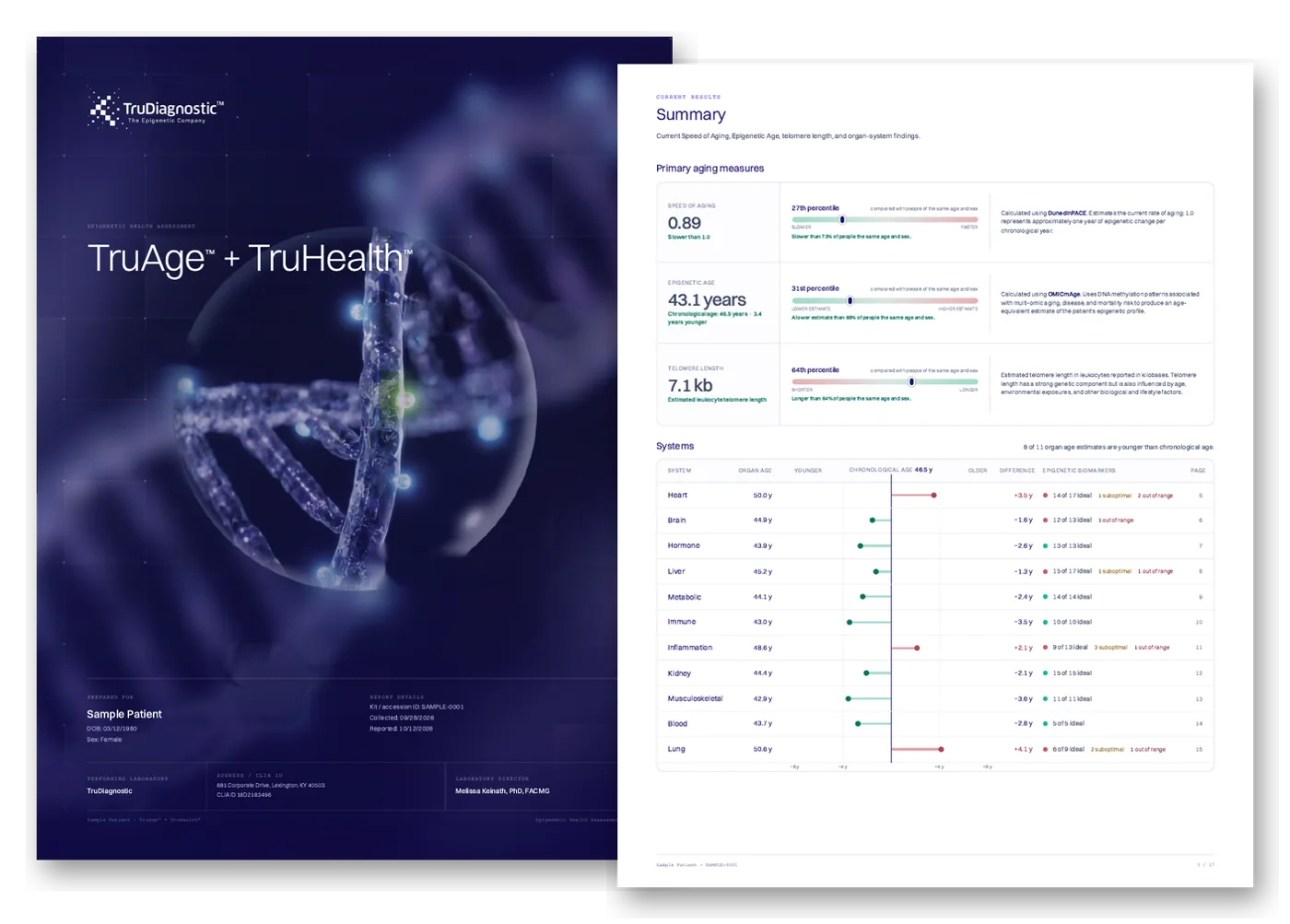
Marker list summarized from TruDiagnostic's published test information and may change as the lab updates its reports. TruHealth values are epigenetic estimates, and I read them alongside your other data. This test guides lifestyle choices and does not diagnose disease.
Your epigenetic package
You receive more than a report. I help you understand what your numbers mean, choose your first priorities, and decide when to retest.
We talk about your goals on a free discovery call and decide whether epigenetic testing is the right first step.
Your kit arrives at your door. Collect a quick sample and mail it back to the lab.
Once your report arrives, we meet virtually to read it and connect it with your history and goals.
After about six months of changes, a retest shows what moved, so your progress becomes proof.
Everything included
Pricing is shared on your free discovery call.
In their words
She came in wanting energy and confidence. Her epigenetic age dropped from 44 to 42 in five months, and she lost 25 pounds along the way.
For more than four years I retested my own biology every six months, changing one variable at a time. Today my biological age measures about ten years younger than my calendar age, with a pace of aging of 0.75.
Frequently asked questions
Biological age, pace of aging, and how we measure progress over time.
If your DNA is the hardware, epigenetics is the software that switches genes on and off. An epigenetic test reads chemical tags on your DNA called methylation marks. Those patterns shift with sleep, food, stress, movement, and environment, which makes them a powerful window into how your body is aging right now.
Your genetic test reads the code you were born with, and it stays the same for life. Your epigenetic test reads how your body is using that code today, and it changes as your lifestyle changes. Genetics shows your starting point. Epigenetics shows your current position and direction, so it's the test we repeat to measure progress.
Your biological age, your pace of aging, and how individual organ systems are aging. It also shows your cellular health at a molecular level, including inflammation, immune health, and hidden nutritional needs, deficits, and excesses. I use TruDiagnostic, a clinical-grade lab, and translate every page into plain language.
At home, with a quick finger-prick blood sample. You mail it back to the lab, and once your results arrive, we meet to decode your report together.
Biological age tells you where you are. Pace of aging tells you how fast you're moving. A pace of 1.0 means your body ages one year for every calendar year, and a lower number means you're aging more slowly. My own pace measures 0.75, so my body ages about nine months for every calendar year.
Yes. Biological age responds to how you live, and we measure that response as a lower biological age and a slower pace of aging from one test to the next. One client measured two years younger in five months. Your calendar age keeps counting. Your biological age is the number you can move.
About every six months, which gives your body enough time to respond to the changes we make. Our Advanced program includes two rounds of epigenetic testing, so you see your progress in your own numbers. Between tests, we change one variable at a time, so we know what moved the needle.
Epigenetic clocks are among the most researched tools in longevity science, and they keep improving. Like any measurement, a single result carries some natural variation, so I focus on trends across tests and read your report alongside your other data. Each new reading sharpens the picture.
Routine labs are designed to flag disease. Epigenetic testing shows how your body is aging at the cellular level, and it can reveal early shifts while your routine labs still read normal. That gives you a head start: time to make changes while you feel well enough to make them with ease.
We meet to decode your report and connect it to your history, your goals, and any other data you have. You leave with a personalized plan across the Seven Pillars and clear priorities for the months ahead. Then we retest, so your progress becomes proof.
Start with a free discovery call, or take the two-minute quiz to see where you stand today.